Mythical Planet: a winged horse, a desert worm and an ice dragon surrounding the planet

Mythical Planet — Fauna dossier

Manticore

Panthera scorpioides aberrans

Series preview · Series 1 · Episode 02

Playlist · Desert Survivors

Explore more
episodes.

Search the archive

01Anatomical highlights

Chitin armour
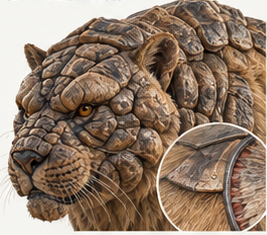
Manticore face and neck showing overlapping chitin armour and a cutaway through a protective plate.

Overlapping chitin plates shield the face, neck and back. Flexible junctions between plates preserve movement while protecting vulnerable areas during hunting and territorial contests.

Jointed tail
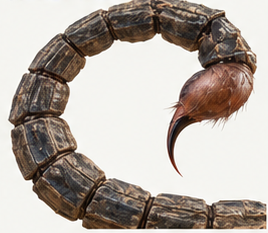
Curved armoured Manticore tail with articulated segments, a terminal venom bulb and a curved stinger.

Articulated tail segments combine protection with flexibility. The elevated tail can curve forward to strike prey or deliver controlled defensive blows during close encounters.

Powerful forequarters
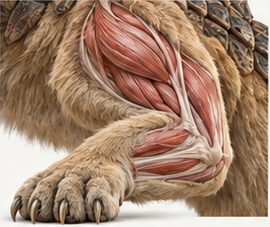
Manticore shoulder and forelimb cutaway showing feline muscles and tendons within the limb, ending in a clawed paw.

Powerful shoulder and forelimb muscles deliver short lunges and hold struggling prey. Heavy armour favours stalking and ambush over prolonged pursuit.

Carnivorous dentition
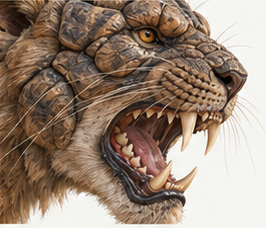
Open Manticore jaws showing long feline canines and shearing teeth beneath a plated face.

Long canines secure mammalian prey, while sharp carnassial teeth shear flesh. The jaws provide a firm grip as the forelimbs and tail subdue a struggling animal.

Territorial encounters
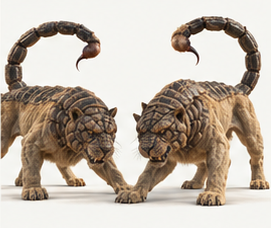
Two complete armoured manticores facing one another with segmented tails and stingers raised during a territorial encounter.

Solitary adults patrol defended territories. During dominance contests, tail strikes can temporarily paralyse rivals, but the venom is non-lethal to other manticores.

02Size comparison
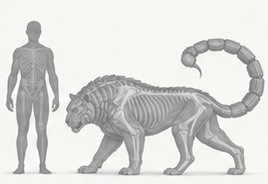
Grey Manticore and human comparison figures with faint internal anatomy on a baseline; body length 1.8–2.1 metres, tail separately 1–1.5 metres, and human height 1.8 metres.

Body length 1.8–2.1 m; tail length 1–1.5 m. A 1.8 m human is shown for comparison.

03Evolutionary relationships
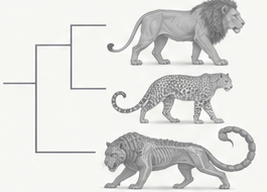
Fine grey evolutionary branches with softly shaded, anatomically detailed grey lion, leopard and Manticore figures, indicating feline ancestry.

Carnivora → Felidae → Panthera → Panthera scorpioides aberrans. Feline ancestry is retained beneath the manticore’s specialised armour and venom-bearing tail.

04Diet & ecology
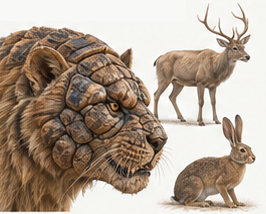
Plated Manticore head beside a small deer and a hare, illustrating its predominantly mammalian diet.

Carnivorous and opportunistic, feeding mainly on mammals. Ambushes, short pursuits and occasional scavenging exploit prey opportunities while limiting the cost of moving heavy armour.

The expedition continues

New episodes.
Every week.

Follow on YouTube

Habitat

Arid scrub, sandy basins and rocky canyons.

Diet

Carnivore; opportunistic hunter feeding mainly on mammals.

Activity pattern

Most active around dawn and dusk; rests in shade during intense heat.

Social structure

Solitary and highly territorial; rivals meet in dominance contests.

Lifespan

10–18 years in the wild.

Watch the film: https://www.youtube.com/watch?v=SBo6turc7oI

Dossier: https://mythical-planet.com/species/manticore/

2 responses to “Manticore”

  1. Tyler C Rakstis

    Critique and concerns on this series:
    I do like that this is an idea that I was hoping someone would bring to life. A docu-fiction style series based on speculative evolution of mythical beasts and cryptids. But the one thing that concerns me is the over-usage of AI imagery. Which, to me feels like a missed opportunity because I wished you could have some actual voice over performer, actual professional scientific consultants and professional creature effects artists to bring this idea to life. But is there anyone else involved in this, other than the three people who had experience in documentaries before in your about page?
    While AI imagery isn’t always a bad thing, but I am a bit concerned about if this might be overused since it might send the wrong message to other companies.That might lead them to think they can do the same on a far greater level, to where artists might be out of a job. This isn’t meant to be a harsh, insulting critique, but I just want to know more about the behind-the-scenes process with this. Since we all know that AI for art is a extremely divisive topic in the artistic medium.
    Please answer when you have the time, and thank you for responding if you do.

    1. Hi Tyler, thanks for taking the time to comment. I’m glad you are somewhat enjoying the series.

      This series is made, essentially, for zero budget, it is self funded by three working wildlife filmmakers (check out our bios) as a way to flex our story telling muscles in a industry that is rapidly retracting. Before making this I pitched this exact series for over ten years, no one would commission it – the cost of making it was simply too high. A series like this with traditional animators would cost in the multiple millions, I know, I’ve won an Emmy for VFX and I budgeted it out.

      We used Ai because it gives us a tool to create something that otherwise would not have been made. And as for the voice? That’s me, with a filter. We’re planning for a behind the scenes series one day soon, but we can only do so much with the resources we have. As for experts – all of us have worked for the best part of two decades making natural history films for the BBC, Nat Geo, PBS, Disney, and more, and are pulling from first hand experience of natural behaviours.

Leave a Reply

Your email address will not be published. Required fields are marked *